


What Is My HVAC Business Worth in Atlanta? 2026 Valuation Guide
Updated: Oct 4
An owner-operated Atlanta HVAC business is usually valued on Seller's Discretionary Earnings (SDE) at roughly 2.0x to 3.5x — so a shop with $300,000 in SDE typically sells for about $600,000 to $1,050,000. Larger companies are valued on EBITDA, and the multiple climbs with size: roughly 3.0x–4.5x under $1M of EBITDA, 5.0x–7.0x from $1M to $3M, and 7.0x or more for platform-scale businesses above $3M. Which framework applies to you — and where you land inside these ranges — depends on seven factors most owners never hear about until a buyer uses them to push the price down.
If you own an HVAC company in metro Atlanta and you've ever asked what it's worth, you've probably gotten one of two answers: a number from a competitor who wanted to buy you cheap, or a number from a broker who wanted to impress you enough to sign a listing agreement.
Neither answer is the right one.
What your HVAC business is actually worth in Atlanta in 2026 depends on a specific set of factors — your adjusted earnings, your maintenance contract book, your technician depth, your facility situation, and which category of buyer your business fits. Get those factors right, and you get a realistic number. Get them wrong, and you either leave money on the table or sit on the market too long wondering why buyers are not materializing.
This guide covers what Atlanta HVAC businesses are actually selling for right now, what drives value up and what drives it down, and what the buyer landscape looks like for your specific size and profile.
The Two Valuation Frameworks You Need to Know
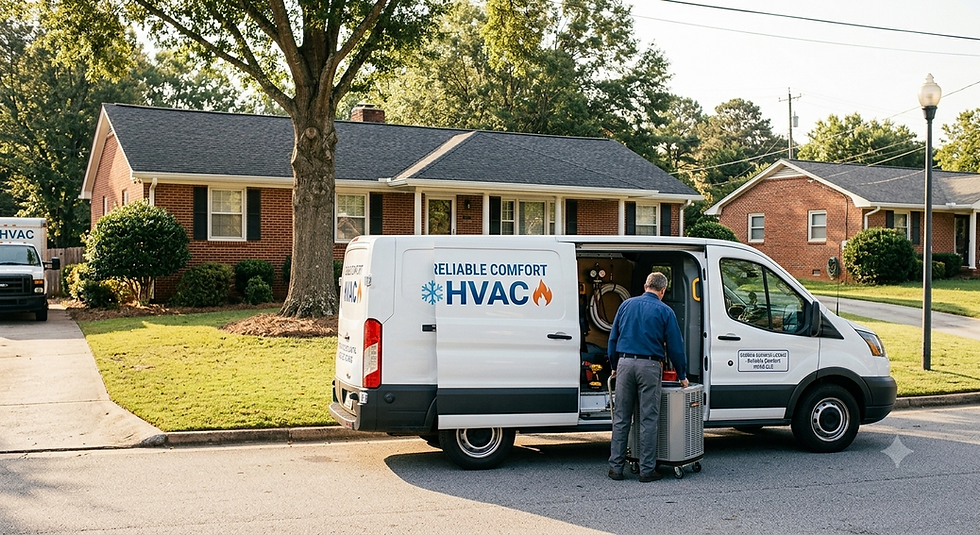
HVAC businesses in Atlanta are valued using one of two frameworks depending on size. Understanding which one applies to your business is the starting point for every other calculation.
Seller's Discretionary Earnings (SDE) — for owner-operated businesses
SDE is the appropriate valuation framework for most Atlanta HVAC companies with annual revenue under approximately $3 million. SDE starts with net income and adds back the owner's compensation, personal benefits, depreciation, amortization, and any one-time or non-recurring expenses. The result is the true economic benefit the business delivers to a full-time owner-operator.
Atlanta HVAC businesses valued on SDE typically trade at 2.0x to 3.5x SDE in today's market. A business generating $300,000 in SDE would typically range from $600,000 to $1,050,000 in market value depending on the specific factors covered below.
EBITDA — for larger businesses attractive to private equity
For HVAC companies with $1 million or more in adjusted EBITDA, the buyer pool widens to include private-equity-backed platforms, which underwrite deals differently than SBA-financed individual buyers and pay higher multiples to build density in a market like Atlanta.
Atlanta HVAC businesses are valued on EBITDA with the multiple rising by size: companies in the $1 million to $3 million EBITDA range are currently trading at roughly 5.0x to 7.0x in competitive processes, while platform-scale businesses above $3 million reach 7.0x to 10.0x or more. A $1.5 million EBITDA HVAC company in metro Atlanta — squarely in the $1–$3 million tier — would realistically transact between about $7.5 million and $10.5 million in a well-run competitive process involving multiple PE-backed buyers. The PE acquisition wave in home services has pushed these numbers to levels that would have been unimaginable ten years ago.
The line between the two frameworks isn't hard — it's a gradient. A business around $750,000 in EBITDA can attract both SBA-financed individual buyers and smaller PE platforms at once, and an experienced broker can use that overlap to create competitive tension and push you toward the top of your range.
The Seven Factors That Drive HVAC Valuation in Atlanta
1. Maintenance Agreement Penetration
This is the single most important value driver in any Atlanta HVAC valuation, and it is the factor that separates good businesses from great ones in the eyes of every buyer category.
Maintenance agreements — annual service contracts that guarantee you access to a customer's equipment twice a year for inspection and tune-up — create recurring, predictable revenue that behaves like a subscription business. PE buyers in particular underwrite maintenance agreement books at premium multiples because recurring revenue dramatically reduces the risk profile of the acquisition.
An Atlanta HVAC company with 800 active maintenance agreements generating $240,000 in annual recurring revenue will command a meaningfully higher multiple than an identical business with zero maintenance agreements and the same total revenue. The recurring portion is worth more per dollar than the transactional portion, and sophisticated buyers will separate and value each component individually.
Before you sell, know your maintenance agreement count, annual renewal rate, and the revenue attributable to that book. It is the first thing every serious buyer will ask for.
2. Owner Dependence
How much of your revenue follows you personally? If your customers call your cell phone, if your key relationships are with you rather than with the business, if your technicians defer to you on technical decisions that a properly trained team should handle independently — buyer lenders will flag this as key-man risk and discount accordingly.
The cleanest Atlanta HVAC exits happen when the business has an operations manager or service manager who runs day-to-day operations, a dispatcher who manages scheduling independently, and customer relationships that are documented in a CRM rather than in the owner's head. If you are two to three years from selling, building this operational independence is the highest-return investment you can make.
3. Technician Depth and Retention
The Atlanta HVAC labor market is tight. Georgia has a genuine skilled technician shortage, and buyers know it. A business with five experienced technicians who have been with the company for an average of four or more years is a fundamentally different acquisition risk than a business with five technicians, two of whom were hired last quarter.
Technician tenure, certification levels, and whether key technicians are likely to stay through an ownership transition all factor into how a buyer underwrites the deal. Employment agreements or retention bonuses tied to a post-close period are increasingly common in Atlanta HVAC transactions for this reason.
4. Revenue Mix: Service vs. Installation
Service and repair revenue — especially residential service calls — is valued more highly than installation revenue in most HVAC valuations. Installation revenue is project-based, lumpy, and does not repeat predictably. Service revenue, particularly when it flows from a maintenance agreement base, is recurring and predictable.
An Atlanta HVAC business with 70% service revenue and 30% installation revenue will typically command a higher multiple than a business with the opposite mix, even at the same total revenue. If your business is heavily installation-weighted, buyers will apply a discount for revenue quality even if your top-line numbers look strong.
5. Georgia Licensing Structure
Georgia Conditioned Air Contractors are licensed by the State Construction Industry Licensing Board under the Georgia Secretary of State. The license is held by an individual qualifier, not the business entity. This means the buyer must have their own licensed qualifier in place on day one of closing — or retain your qualifier under an employment or consulting agreement with specific terms.
License transition planning must begin before the sale process, not during due diligence. Buyers who discover a licensing gap mid-process use it as negotiating leverage. Buyers who knew about it from the start, with a clean solution already in place, do not.
6. Facility and Real Estate Situation
Your truck yard, your parts inventory storage, your shop space — how these are structured affects your valuation in ways that most HVAC owners and many business brokers do not fully address.
A truck yard on a month-to-month lease introduces lender uncertainty. An owned commercial building raises the question of whether to sell it with the business or retain it as a landlord. Below-market lease terms add value that needs to be documented. Above-market rent suppresses SDE and therefore suppresses your multiple.
As a KW Commercial agent, Travis Bryenton addresses the real estate component of every Atlanta HVAC transaction in-house, not as a referral. This is particularly important for PE acquisitions, where the buyer's due diligence team will scrutinize facility arrangements closely.
7. Financial Presentation and Documentation
Buyers and their lenders do not take your word for your earnings. They verify. Clean, well-organized financials — three years of tax returns, three years of profit and loss statements, and a clear add-back schedule that documents and explains every SDE or EBITDA adjustment — compress due diligence timelines and give buyers confidence that reduces deal risk premiums.
Messy financials — commingled personal and business expenses, undocumented cash transactions, inconsistent revenue recognition — introduce uncertainty that buyers price in conservatively. The same business with clean financials versus messy financials can transact at meaningfully different prices, simply based on how much risk a buyer perceives in the numbers.
The Atlanta Buyer Landscape in 2026
Who is buying Atlanta HVAC businesses right now, and what does each buyer type mean for your valuation?
PE-backed strategic platforms are the most active and highest-paying buyer category for Atlanta HVAC companies above the $1 million EBITDA threshold. Wrench Group — the Atlanta-based platform behind Coolray, now backed by TSG Consumer Partners and Oak Hill alongside Leonard Green & Partners and management — is an active acquirer in the metro. Apex Service Partners, one of the largest residential HVAC, plumbing, and electrical roll-ups in the country, is also expanding across metro Atlanta through tuck-in acquisitions. These buyers pay PE-level multiples and move on defined acquisition timelines — but they also run rigorous due diligence processes and have professional acquisition teams negotiating on their behalf.
Regional strategic buyers — larger independent HVAC companies looking to expand their Atlanta footprint — occupy the middle of the market. They typically pay above SDE-based multiples but below PE-level EBITDA multiples, and they move faster and with less due diligence complexity than PE platforms.
Individual buyers using SBA financing are the primary buyer category for Atlanta HVAC businesses valued under approximately $3 million. SBA 7(a) loans can finance up to $5 million for business acquisitions, with terms of up to 10 years and down payments as low as 10%. This buyer type is highly active in the Atlanta market, and the competition among qualified SBA buyers for well-run HVAC companies has supported the upper end of the 2.0x to 3.5x SDE range in recent transactions.
Employee buyouts are possible but require specific structuring. An SBA loan to a qualified employee with management experience and clean credit is a realistic path for some Atlanta HVAC transitions, particularly where owner dependence is high, and the buyer-employee relationship provides a transition continuity premium.
What a Realistic Atlanta HVAC Valuation Looks Like
Three examples based on current market conditions:
Example A — Owner-operated, $275,000 SDE, 400 maintenance agreements, clean financials, technician team of 4. Valuation range: $605,000 to $880,000 (2.2x to 3.2x SDE). Buyer type: Individual SBA buyer or regional strategic. Key driver toward upper end: maintenance agreement book and technician tenure
Example B — a growing Atlanta HVAC company with $650,000 in adjusted EBITDA. Because it's still under $1 million in EBITDA, it's valued in the 3.0x to 4.5x range — roughly $1,950,000 to $2,925,000. Stronger recurring maintenance revenue, lower owner dependence, and clean, well-documented books push it toward the top of that range; heavy reliance on one-off installation work and an owner who runs every job pull it toward the bottom.
Example C — an Atlanta HVAC company with $1.4 million in adjusted EBITDA. Sitting in the $1 million to $3 million tier, it's valued at roughly 5.0x to 7.0x — about $7.0 million to $9.8 million. Documented systems, a deep maintenance-contract base, and a management layer that runs the business without the owner push it toward the top of that range and open the door to platform buyers; owner dependence and thin recurring revenue hold it down.
** These ranges reflect 2026 HVAC M&A data; your actual multiple depends on recurring maintenance revenue, technician retention, service mix, owner dependence, and buyer type. The only way to know your real number is a confidential valuation on your actual financials.
The Confidential Valuation Process
The only way to get a number that is actually useful — rather than aspirational or conservative — is to go through your specific financials, your maintenance agreement book, your technician roster, your lease, and your licensing structure with a broker who knows the Atlanta HVAC buyer landscape.
Travis Bryenton provides confidential HVAC business valuations for Atlanta-area owners at no cost and no obligation. You will come away with a realistic price range, a clear picture of which buyer category your business fits, and an honest assessment of what — if anything — would improve your outcome before going to market.
Travis Bryenton | KW Commercial | Keller Williams Buckhead
3650 Habersham Road NW, Atlanta, GA 30305 678-631-9696
GABB Member | IBBA Member
Travis Bryenton is an Atlanta business broker and KW Commercial agent specializing in HVAC, plumbing, electrical, and landscaping business sales across metro Atlanta. He serves trade business owners in Fulton, Cobb, Gwinnett, DeKalb, and Cherokee counties.
Frequently Asked Questions
What is an HVAC business worth in Atlanta in 2026?It depends on size and how it's valued. A small, owner-operated Atlanta HVAC shop is usually valued on Seller's Discretionary Earnings (SDE) at about 2.0x to 3.5x — so $300,000 in SDE translates to roughly $600,000 to $1,050,000. Larger companies are valued on EBITDA, and the multiple rises with scale: about 3.0x to 4.5x under $1M of EBITDA, 5.0x to 7.0x from $1M to $3M, and 7.0x to 10.0x or more for platform-quality businesses above $3M. Recurring maintenance revenue, technician retention, and service mix determine where you land.
Should my HVAC business be valued on SDE or EBITDA?Small, owner-operated HVAC businesses are valued on SDE (about 2.0x to 3.5x), because the owner's hands-on income is the real return a buyer is purchasing. Once a company is large enough to run without the owner — generally $1M or more in EBITDA — buyers switch to EBITDA, which runs about 5.0x to 7.0x in the $1M to $3M range and 7.0x to 10.0x or more for platform-scale businesses. Being valued on the wrong framework — or quoted a platform multiple your business hasn't earned — is the most common way Atlanta HVAC owners get mispriced.
How much do maintenance agreements add to my HVAC business value?They're the single biggest value driver. Recurring maintenance contracts are predictable revenue a buyer can bank on, so dense contract books earn higher multiples and draw more buyers. For example, 800 maintenance agreements billed at $150 to $300 each generate roughly $120,000 to $240,000 in predictable annual revenue — the kind of recurring base that moves you toward the top of your valuation range versus a business living on one-off service calls.
Does my Georgia HVAC license affect the sale?Yes. Georgia's licensing structure — including how the qualifying agent/license transfers to a buyer — can speed up or stall a deal, and Georgia's skilled-technician shortage makes technician depth and retention a direct valuation factor. Buyers price in how easily they can keep the license and the crew after closing.
How does my shop lease or building affect the valuation?Significantly. A shop or truck yard on a month-to-month lease introduces lender and buyer uncertainty that can lower your price, while a long assignable lease or owned real estate can raise it. As a KW Commercial agent, Travis Bryenton handles the real-estate and lease side of every Atlanta HVAC sale in-house — not as an outside referral — which most business brokers can't do.
What's the first step to getting a real valuation of my Atlanta HVAC business?Start with a confidential valuation from a licensed local broker, not a competitor's lowball offer or a listing-pitch number. Travis Bryenton — GABB and IBBA member, KW Commercial / Keller Williams Buckhead, 3650 Habersham Road NW, Atlanta, GA 30305 — runs a confidential HVAC valuation process. Call 678-631-9696 or email TravisBryenton@KW.com.
Comments